
A Modern Community in a Historic Setting
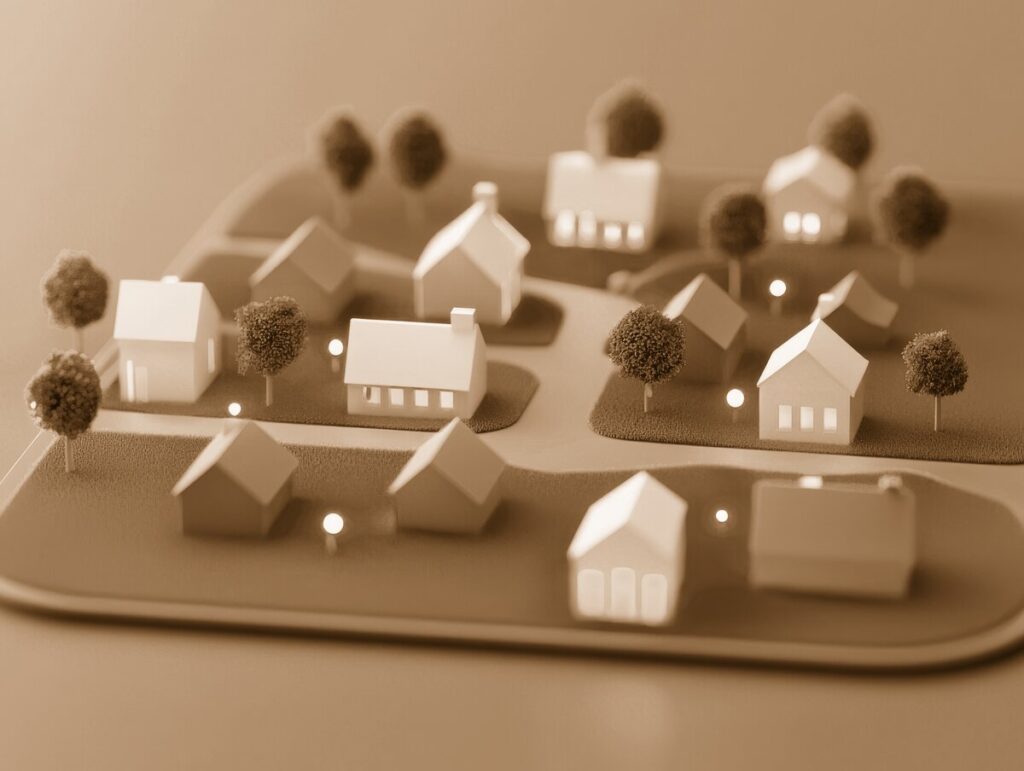
Parkway Crossing is one of Westlake’s newer residential communities, but its setting connects naturally to the much older story of the city around it. Located in northern Westlake, just west of Cahoon Road and about three-quarters of a mile north of Detroit Road, the neighborhood sits near the same broad landscape that once supported farms, orchards, woodlots, rail transportation, and country homes. Today, its townhomes, ponds, sidewalks, and wooded common areas give the community a distinctly modern character while still reflecting Westlake’s long transition from rural township to established suburb.
Parkway Crossing was developed by Pulte Homes between approximately 2020 and 2023. The community includes 144 limited-maintenance townhomes arranged in three sections. Its streets include Bayberry Court, Serviceberry Court, Woodside Drive, Ironwood Court, South Greenway Drive, South Parkside Drive, Birchwood Court, North Greenway Drive, and North Parkside Drive. Together, they form a compact neighborhood with a gentle, park-like layout.
How Parkway Crossing Got Its Name
The name Parkway Crossing appears to be tied to the neighborhood’s location near Westchester Parkway, the principal route leading into the development. Public real-estate descriptions place the community immediately off Westchester Parkway, which connects the residential area with Cahoon Road and the larger Westlake street network. The word “Crossing” fits the development’s design as a transition point between established neighborhoods, wooded land, parkland, and nearby employment areas.
Unlike older Westlake roads such as Cahoon, Porter, Crocker, and Clague, Parkway Crossing is not named for one of the city’s pioneer families. It is a contemporary neighborhood name, created during the community’s development rather than inherited from the early township period. That distinction is part of what makes Parkway Crossing interesting: its identity belongs to the latest chapter of Westlake’s growth.
The Older Story Beneath the Neighborhood
To understand Parkway Crossing, it helps to look back to Westlake’s beginnings. The area was originally part of Dover Township, established in 1811 after settlers from Connecticut arrived in the Connecticut Western Reserve. Dover Village was incorporated in 1911, became Westlake Village in 1940, and was incorporated as the City of Westlake in 1957. The name change from Dover was made largely to prevent confusion with another Ohio community named Dover.
Many of Westlake’s familiar streets preserve the names of the families who cleared land and built homes here. Cahoon Road recalls the Cahoon family, while Porter Road honors another early family whose name is also carried by Westlake Porter Public Library. Crocker Road reflects the Crockers, and Clague Road and Clague Park preserve the memory of the Clague family, immigrants from the Isle of Man who became important landowners and community leaders.
The land surrounding Parkway Crossing was shaped by the same forces that transformed the rest of Westlake. During the nineteenth century, Dover Township was known for agriculture, small fruits, vineyards, and garden farms. In fact, the township became one of the country’s significant grape-shipping centers during the late 1800s. Later, improved roads, the Nickel Plate Railroad, and eventually Interstate 90 made the area increasingly accessible to Cleveland commuters and businesses.
A Neighborhood Built in Three Sections
Parkway Crossing’s development took place in three sections. The southeastern portion includes Bayberry Court, Serviceberry Court, and Woodside Drive. The southwestern section includes Ironwood Court, South Greenway Drive, and South Parkside Drive. The northern section includes Birchwood Court, North Greenway Drive, and North Parkside Drive. This phased arrangement gives each part of the neighborhood a slightly different relationship to surrounding land and streets.
The community was designed for a low-maintenance lifestyle. The two-story townhomes feature front-entry garages, open living areas, modern kitchens, patios, and upstairs bedrooms. Sidewalks, street trees, lighting, visitor parking areas, and landscaped entrances contribute to the neighborhood’s cohesive appearance. The homeowners association maintains shared landscaping, mowing, and snow removal, helping Parkway Crossing retain a cared-for appearance through every season.
One of the neighborhood’s most memorable features is its open space. Parkway Crossing includes approximately 23.62 acres of HOA-owned common area, much of it wooded. Fountains and ponds provide water views, while privacy panels and landscaped edges help soften the transition between homes. For residents, those features offer more than visual appeal; they create the feeling of living beside a small nature preserve rather than in a tightly packed subdivision.
Nearby Parks and Landmarks
The northern edge of Parkway Crossing is especially connected to Westlake’s recreational landscape. The neighborhood lies near Roman Park, a city-owned park of approximately 13.7 acres within a larger tract of protected or undeveloped city land. This proximity gives residents access to open space and reinforces the community’s woodland setting.
A short drive south brings residents toward Detroit Road, one of Westlake’s most important commercial corridors, while Cahoon Road provides a direct north-south connection through the city. Interstate 90 is also nearby, making Cleveland, Lorain County, and other regional destinations convenient for commuters. The Lake Erie shoreline is roughly a mile away, placing beaches, lake breezes, and the neighboring communities of Bay Village and Rocky River within easy reach.
Westlake’s historic landmarks are also close enough to become part of a Parkway Crossing resident’s everyday understanding of the city. The Clague House, operated as a museum by the Westlake Historical Society, preserves the story of one of the area’s early families. Evergreen Cemetery near Center Ridge Road contains the graves of many early settlers, including members of the Johnson family. Westlake Porter Public Library continues the tradition of civic investment begun by Leonard Porter, who left money and books to help establish a public library in the nineteenth century.
From Farmland to Connected Suburb
Westlake’s growth accelerated after World War II. The city’s population rose sharply during the 1950s and 1960s as families sought newer homes, larger lots, and convenient access to Cleveland. Zoning, new roads, schools, shopping areas, and business districts gradually replaced much of the old agricultural landscape. Interstate 90 added another layer of momentum by making Westlake easier to reach from throughout Northeast Ohio.
Parkway Crossing represents the newest version of that long evolution. It is not a nineteenth-century village street or a collection of preserved farmhouses. Instead, it is a carefully planned neighborhood created for contemporary life: flexible interiors, shared maintenance, nearby employment, access to schools, and a strong connection to green space.
What Makes Parkway Crossing Special
What makes Parkway Crossing special is the balance between new construction and old surroundings. Residents can enjoy modern townhome living while still being close to streets named for pioneer families, historic cemeteries, long-established parks, library traditions, and the broader landscape of former Dover Township.
On a quiet evening, the neighborhood’s wooded edges and pond views offer a reminder that Westlake’s heritage was never only about buildings. It was also about land—fields, groves, roads, waterways, and the steady movement from one generation to the next. Parkway Crossing continues that story in its own way, adding a new community to a city that has always known how to grow while keeping one eye on where it began.